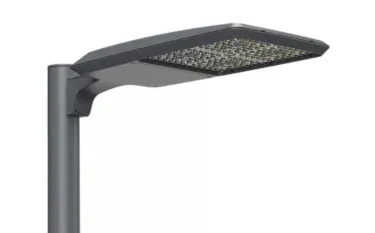
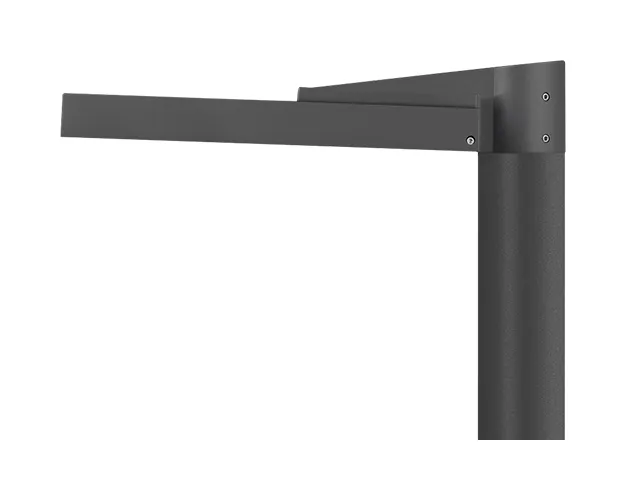
Parking lot lighting is where energy codes, dark-sky ordinances, security expectations, and pole economics all collide on one site plan. Get the photometrics right on paper and the field result is predictable; guess at optics or spacing and you end up with dark pockets between poles or light trespassing onto the neighbor’s property.
Design to a light level, not a wattage
Start from the target illuminance, not a fixture catalog number. The reference is IES RP-20, Lighting for Parking Facilities, which sets minimum maintained horizontal illuminance for open lots: roughly 0.2 fc for a basic parking area and 0.5 fc for enhanced-security areas, with maximum-to-minimum uniformity of about 20:1 (tighter, 15:1, for enhanced security). Where personal security matters — stairs, pay stations, pedestrian crossings — vertical illuminance at ~5 ft above grade is what lets a camera or a person actually recognize a face, so specify it separately from the horizontal average.
These are maintained values. Apply a light-loss factor (typically 0.85–0.9 for a quality LED area light over its rated life) so the lot still meets target years after commissioning, not just on day one.
Pick the IES distribution type to the pole location
Area optics are classified by IES distribution type, and matching the type to where the pole sits is what controls uniformity and spill:
- Type II — narrow lots, perimeter drives, and roadway-edge poles.
- Type III — the workhorse for general lot rows where poles sit along one side of the drive aisle.
- Type IV — forward-throw for perimeter and building-mounted poles, pushing light into the lot and keeping it off the property line behind.
- Type V — square or round symmetric throw for poles in the middle of large open lots or islands.
A single lot often mixes types: Type V on interior islands, Type IV or III along the boundary so light stays on-site.
Pole height sets spacing — and the pole count sets the budget
Taller poles cover more area per fixture, so mounting height is the biggest lever on total pole count (and trenching, bases, and installed cost). Typical commercial lots run 20–39 ft mounting heights, with luminaire spacing on the order of 3–4× the mounting height for acceptable uniformity. Fewer, taller poles with higher-lumen packages usually beat a dense grid of short poles on installed cost — but check local zoning, which frequently caps pole height near residential edges.
Keep the light on the ground: BUG and dark-sky limits
Modern outdoor codes and dark-sky ordinances are written around the IES BUG rating (Backlight–Uplight–Glare, from IES TM-15). The one non-negotiable for most jurisdictions is U0 — zero uplight, i.e. a full-cutoff luminaire. Backlight (B) and glare (G) limits tighten as the fixture sits closer to a property line (the “lighting zone”). House-side shields and correct aiming keep the B rating low at the boundary. Warmer CCTs help too: many dark-sky ordinances now cap outdoor lighting at 3000K or below to limit blue-light skyglow, and 3000K reads perfectly well in a parking lot.
Controls are mandatory now, not optional
Energy codes (California Title 24, and ASHRAE 90.1 by reference in most of the US) require outdoor lighting controls, so build them in from the start:
- Photocell / astronomical time switch for dusk-to-dawn operation — the baseline.
- Motion step-dimming: fixtures hold a low state (often 20–50%) when the area is empty and boost to full on occupancy. This is where most of the after-hours savings come from, and codes increasingly mandate an automatic reduction during unoccupied periods.
- Networked / addressable controls when the site has many poles or wants remote monitoring and per-fixture scheduling.
Datasheet checklist
- Delivered lm/W ≥ 130 at the fixture (not the LED chip), at the CCT you’re specifying.
- IES distribution type + BUG rating published, and an .ies file so your photometric layout is real, not assumed.
- U0 uplight to satisfy dark-sky and full-cutoff requirements.
- 10 kV surge protection — parking lot poles are exposed and see supply transients.
- L70 ≥ 100,000 h and a 10-year warranty; relamping at pole height is a bucket-truck line item.
- Field-adjustable output/CCT if you want to tune lumen packages or color after install without re-ordering.
For the fixtures themselves, start from the area & post-top lights category, and pair perimeter poles with building-mounted wall packs and flood lights where the architecture, not a pole, is the logical mounting point.